
Walking vs Cycling for Weight Loss: Which Is Better for Beginners?
Walking and cycling can both support fat loss. Use this practical comparison to choose the option that fits your time, joints, budget, and routine—and learn when combining both makes more sense.
Click a star to rate

The short answer
For weight loss, walking is usually the better starting point when you want the lowest-cost, lowest-skill option you can do almost anywhere. Cycling may suit you better if you have less time, prefer a lower-impact seated workout, or can ride at a comfortably challenging pace.
Neither activity has a built-in fat-loss advantage. The deciding factor is the amount of movement you can repeat week after week while your overall eating pattern supports a calorie deficit. A demanding bike ride that happens twice a month will usually do less than regular walks you actually keep doing.
This is a researched comparison. No personal testing, product ownership, or clinical credentials were supplied for this article.
Choose walking if / choose cycling if
| Choose walking if... | Choose cycling if... |
|---|---|
| You want to start today with little or no equipment. | You prefer a seated, low-impact workout. |
| You can build movement into errands, breaks, or commutes. | You want to reach a higher effort level in less time. |
| You feel unsure about bike handling, traffic, storage, or maintenance. | You have safe routes or a stationary bike you will use. |
| You enjoy simple daily habits more than planned workouts. | You find walking repetitive or uncomfortable at longer durations. |
| Your budget is limited to supportive footwear and weather-appropriate clothing. | You can account for the bike, helmet, lights, upkeep, and safe riding conditions. |
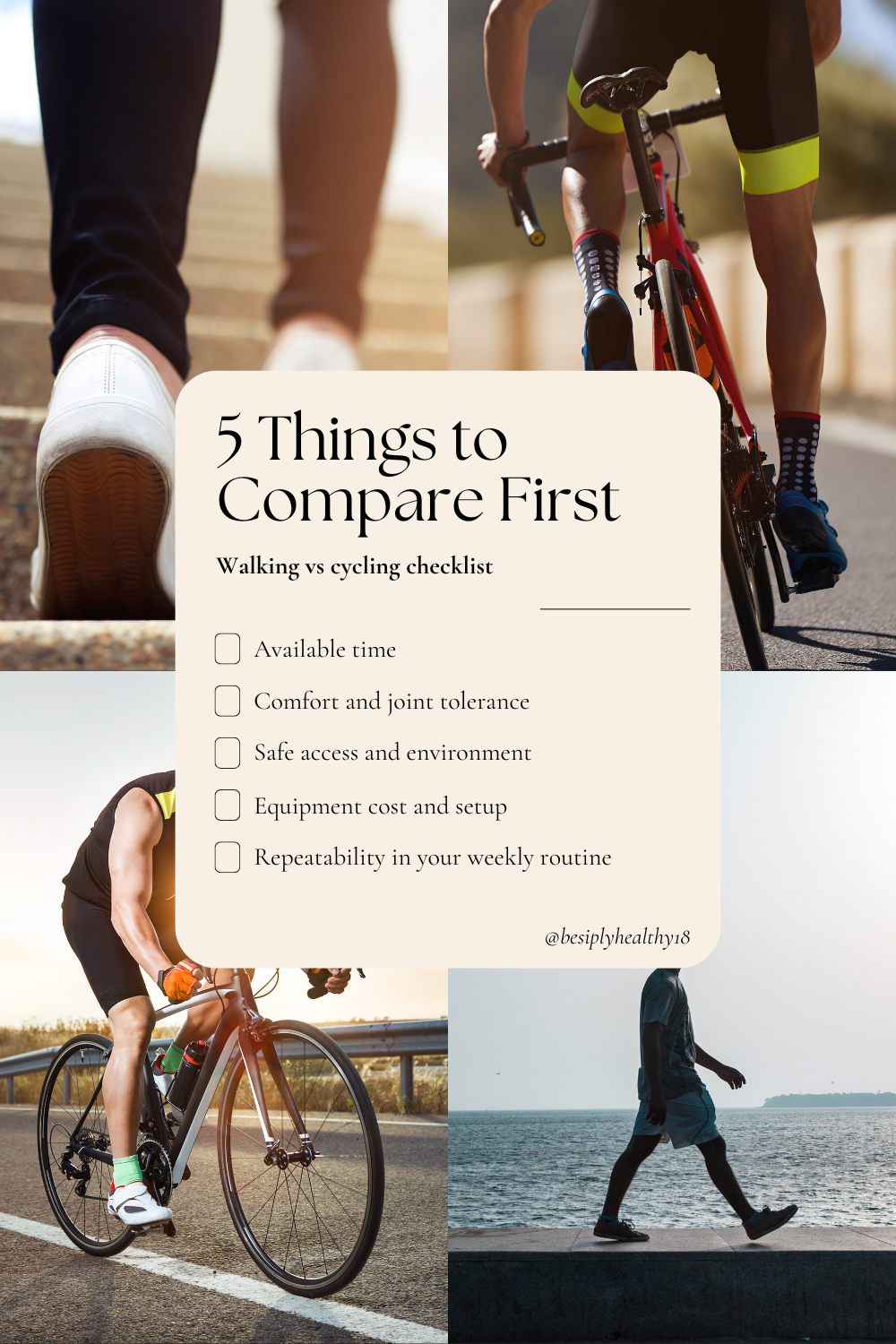
Weight loss is about the whole weekly pattern
Walking and cycling both use energy, but weight change is not determined by one workout or a number displayed on a machine. It reflects the longer-term relationship between energy intake and energy expenditure. Exercise can raise your daily or weekly energy use, improve fitness, and make a routine feel more structured. It does not guarantee weight loss if eating changes cancel out that added activity.
This matters because calorie estimates can look more precise than they are. A cycling app cannot know your exact resistance, fitness, body mass, wind, terrain, or whether you coasted for part of the ride. A walking estimate changes with pace, hills, body size, and how long you keep moving. Treat those numbers as rough feedback, not a food budget you must spend.
The U.S. Physical Activity Guidelines state that physical activity and calorie intake both matter for weight management. Adults are generally encouraged to work toward 150 to 300 minutes a week of moderate-intensity aerobic activity, or 75 to 150 minutes of vigorous activity, plus muscle-strengthening work on two or more days a week. Some movement is better than none, so a beginner does not need to hit the upper end in week one. [Physical Activity Guidelines for Americans, 2nd edition](https://health.gov/sites/default/files/2019-09/Physical_Activity_Guidelines_2nd_edition.pdf)
The difference that matters: intensity you can sustain
At the same duration, a harder cycling session can use more energy than an easy walk. But “cycling” covers a wide range: an easy spin on a flat path is different from a hill ride or a stationary-bike session with meaningful resistance. Walking ranges too, from a relaxed stroll to a brisk uphill walk.
A simple tool is the talk test:
- •Moderate effort: you can talk in full sentences, but singing would be difficult.
- •Vigorous effort: you can say only a few words before needing a breath.
For many beginners, brisk walking and comfortable cycling both land in the moderate range. That is useful, not second-best. Moderate activity is easier to repeat, can be spread across the week, and gives you time to improve gradually.
Do not choose cycling only because an online chart says it burns more. If the bike setup makes you avoid the workout, the theoretical advantage disappears. Do not choose walking only because it is simple if a short bike ride is the one form of cardio you genuinely look forward to.
Walking: the strongest case is convenience
Walking is easy to attach to existing life. You can take a 10-minute walk after lunch, walk part of an errand, use a phone call as a cue to move, or take a longer route home. That flexibility helps beginners accumulate activity without needing a separate workout block.
It also has a low financial barrier. Supportive footwear that fits well, clothing for the weather, and a reasonably safe route may be all you need. There is no charging, storage, tune-up, or learning curve for gear shifting and braking.
Walking does have limits. It takes more time to build a large weekly training volume at an easy pace. Long walks can become uncomfortable if you increase distance too quickly, walk on hard surfaces with worn-out shoes, or ignore recurring foot, knee, hip, or back pain. Adding speed, gentle hills, or short incline intervals can make walking more challenging without turning every outing into a run.
A realistic walking progression
If you are inactive now, start with 15 to 20 minutes at a pace that feels purposeful but manageable, three to five days a week. After one or two comfortable weeks, add five minutes to selected walks or add one short walk after a meal. The useful target is not a perfect step count. It is a weekly routine you can repeat.
Cycling: the strongest case is efficient low-impact cardio
Cycling can make it easier to work at a higher cardiovascular effort without the repeated impact of walking or running. An indoor bike also removes weather and route-planning barriers. For someone with a packed schedule, a 25-minute ride with enough resistance to feel moderately hard may be easier to schedule than a longer walk.
Outdoor cycling has practical benefits beyond exercise: it can replace short car trips or create a social hobby. It also carries practical tradeoffs. You need a correctly sized, maintained bike; a helmet; safe riding conditions; visibility gear when appropriate; storage; and enough confidence to ride. Traffic risk and road quality are not minor details, especially for beginners.
Stationary bikes remove traffic concerns but still need sensible setup. A saddle that is far too low or high, resistance that is increased too fast, and long sessions before your body adapts can lead to avoidable discomfort. Adjust the bike according to its manual, begin with a comfortable resistance, and change one training variable at a time: duration, frequency, or effort.
A realistic cycling progression
Begin with 20 minutes at an easy-to-moderate effort, three days per week. Once that feels routine, add a fourth day or extend two rides by five minutes. Later, try a few brief periods of slightly higher resistance separated by easy pedaling. You should finish feeling like you worked, not like you need several days to recover.
Which is easier on the joints?
Cycling is often described as low impact because you are seated and the pedals guide a smooth circular motion. That can make it a comfortable option for some people. It is not automatically pain-free or suitable for every knee, hip, back, balance, or cardiovascular concern. Fit, posture, resistance, prior injury, and training load all matter.
Walking is also a natural, accessible activity, but it is weight-bearing and may aggravate symptoms for some people when duration, hills, pace, footwear, or surface are not well matched to their current capacity.
Use symptoms as information. Mild muscle fatigue that settles is different from sharp pain, swelling, chest discomfort, dizziness, or pain that persists or worsens. Stop the activity and seek medical advice promptly for concerning symptoms. If you have a known condition, recent surgery, or repeated joint pain, a clinician or qualified physical therapist can help you choose a starting dose.
The budget comparison is more than the purchase price
Walking is usually cheaper to begin, but neither activity needs an expensive product to work. A purchase should solve a real barrier.
| Need | Lower-cost starting option | When an upgrade may be useful |
|---|---|---|
| Walking comfort | Well-fitting shoes you already own if they are in good condition | Supportive walking shoes when current footwear is worn, uncomfortable, or unstable |
| Weather and visibility | Water, sun protection, reflective layer or light where needed | Weather-specific outerwear for frequent outdoor use |
| Cycling access | Borrowed bike, shared bike, or basic safe indoor option | A properly fitted bike or stationary bike when you have a consistent plan to use it |
| Cycling safety | Helmet and basic lights/reflectors appropriate to conditions | Lock, repair kit, brighter lights, or storage once riding becomes regular |
If this page contains affiliate links, they should be clearly disclosed near the recommendation. Commission should never decide the verdict. Avoid buying a premium indoor bike before proving that cycling fits your schedule; a modest option used consistently is more valuable than advanced equipment collecting dust.
A better beginner plan: use the option with the fewest obstacles
Try this two-week experiment before committing to one method.
Week 1: walking baseline
Take four 20-minute walks. Keep the effort comfortable enough to repeat. Note only three things afterward: how easy it was to start, how your body felt later that day, and whether the time fit your routine.
Week 2: cycling trial
If you have safe access to a bike or stationary bike, do three 20-minute rides at a similar moderate effort. Note the same three things. Do not compare calorie readouts. Compare friction: setup, comfort, confidence, time, and willingness to do it again.
At the end, choose the activity that earned more “yes” answers. If both work, keep walking as your flexible daily movement and use cycling one or two times per week for variety or a more time-efficient cardio session.
Common mistakes that make either option less effective
Treating one hard workout as the plan
A single long walk or intense ride does not replace an ongoing routine. Build frequency first; then increase duration or effort.
Raising food intake without noticing
Exercise can increase appetite in some people. Plan satisfying meals with protein, fiber-rich foods, and regular hydration instead of relying on a post-workout reward system.
Progressing every variable at once
Doubling duration, adding hills, and increasing pace in the same week makes discomfort more likely. Change one variable, allow your body to adapt, then reassess.
Ignoring strength training
Cardio is useful, but muscle-strengthening activity is also part of adult physical-activity guidance. Two full-body sessions per week can complement walking or cycling and help build a more balanced routine.
The verdict: choose the one you will repeat
Choose walking if you need the easiest, cheapest way to build a daily movement habit. It is particularly strong for beginners who benefit from short, frequent sessions and who want exercise to fit around ordinary life.
Choose cycling if you prefer a seated workout, want to make limited exercise time feel more challenging, and have safe, practical access to a bike or indoor cycle.
Choose both if variety helps you stay consistent. There is no prize for loyalty to one mode of cardio. The useful plan is the one you can perform safely this month, adjust as your fitness improves, and support with an eating pattern that matches your weight-loss goal.
FAQ
Is walking or cycling better for losing belly fat?
Neither can target fat loss from one body area. Walking and cycling can both contribute to overall fat loss when they help create a sustained calorie deficit. Where the body loses fat first is not something you can choose with a particular exercise.
How much should I walk or cycle to lose weight?
Start below the amount that makes you quit. A practical beginning is three to five sessions of 15 to 30 minutes per week, then gradual progression. General adult guidance calls for 150 to 300 minutes of moderate activity weekly for substantial health benefits, but the right starting point depends on your current capacity.
Does cycling burn more calories than walking?
It can, especially at a higher effort, but there is no universal answer. Speed, resistance, terrain, incline, body size, and duration change the estimate. A routine you repeat is more useful than chasing the biggest number per session.
Is a stationary bike worth buying for weight loss?
It can be worthwhile if weather, safety, or convenience stop you from exercising and you know you enjoy cycling. First try borrowing, using a gym bike, or testing short sessions when possible. Buy based on a proven habit, not a calorie promise.
Can I alternate walking and cycling?
Yes. Alternating can reduce boredom and spread training stress across different movement patterns. Keep the weekly total manageable, especially when you are new to exercise.
Sources
- •[World Health Organization: Physical activity](https://www.who.int/news-room/fact-sheets/detail/physical-activity)
- •[U.S. Department of Health and Human Services: Physical Activity Guidelines for Americans, 2nd edition](https://health.gov/sites/default/files/2019-09/Physical_Activity_Guidelines_2nd_edition.pdf)
- •[American College of Sports Medicine position stand on physical activity and weight loss](https://pubmed.ncbi.nlm.nih.gov/19127177/)
- •[Systematic review: Health benefits of cycling](https://pubmed.ncbi.nlm.nih.gov/21496106/)
Comments (0)
Share your thoughts and experiences
No comments yet. Be the first to share your thoughts!