
Morning vs Evening Workouts: Evidence-Based Guide for Fat Loss and Fitness
Discover whether morning or evening workouts are better for fat loss, weight management, exercise performance, and long-term consistency. Evidence-based guide for beginners seeking sustainable results.
Click a star to rate

One of the most common fitness questions is whether morning workouts or evening workouts are better for fat loss.
Many people believe that exercising early in the morning burns more fat, while others argue that evening workouts are superior because performance is often higher later in the day.
The reality is more nuanced.
Current evidence suggests that workout timing can influence energy levels, performance, exercise adherence, and personal preference. However, for most adults, consistency remains one of the most important factors affecting long-term results.
If your goal is sustainable fat loss, improved fitness, and better health, the best workout time is usually the one that you can maintain consistently.
Quick Answer
For most people, neither morning nor evening workouts have a major advantage for long-term fat loss.
Morning workouts may help some people build consistency and reduce schedule conflicts.
Evening workouts may support better exercise performance due to natural daily changes in body temperature and physical readiness.
The best workout time is the one that fits your schedule, energy levels, and lifestyle.
Key Takeaways
- •Fat loss is driven primarily by long-term calorie balance and consistent activity.
- •Morning workouts may improve adherence for some individuals.
- •Evening workouts often support higher strength and performance.
- •Exercise timing affects people differently.
- •Sleep, nutrition, recovery, and consistency matter more than the specific hour you exercise.
- •A realistic schedule is usually more effective than a theoretically perfect one.
Why People Care About Workout Timing
Many fitness trends promote the idea that there is a perfect time to exercise.
Common claims include:
- •Morning workouts burn more fat
- •Fasted cardio is superior for weight loss
- •Evening workouts ruin sleep
- •Exercising later in the day burns more calories
While some of these ideas contain elements of truth, they are often oversimplified.
Human physiology is influenced by circadian rhythms, individual preferences, work schedules, sleep patterns, and training goals.
Because of these factors, the best workout time varies from person to person.
Understanding Circadian Rhythm
Circadian rhythm refers to the body's internal 24-hour clock.
This system influences:
- •Sleep and wake cycles
- •Hormone production
- •Body temperature
- •Alertness
- •Physical performance
Many physiological processes change throughout the day.
For example, body temperature often rises as the day progresses.
Higher body temperature may contribute to improved muscle function, flexibility, and exercise performance during afternoon and evening hours.
However, lifestyle factors can be just as important as biology.
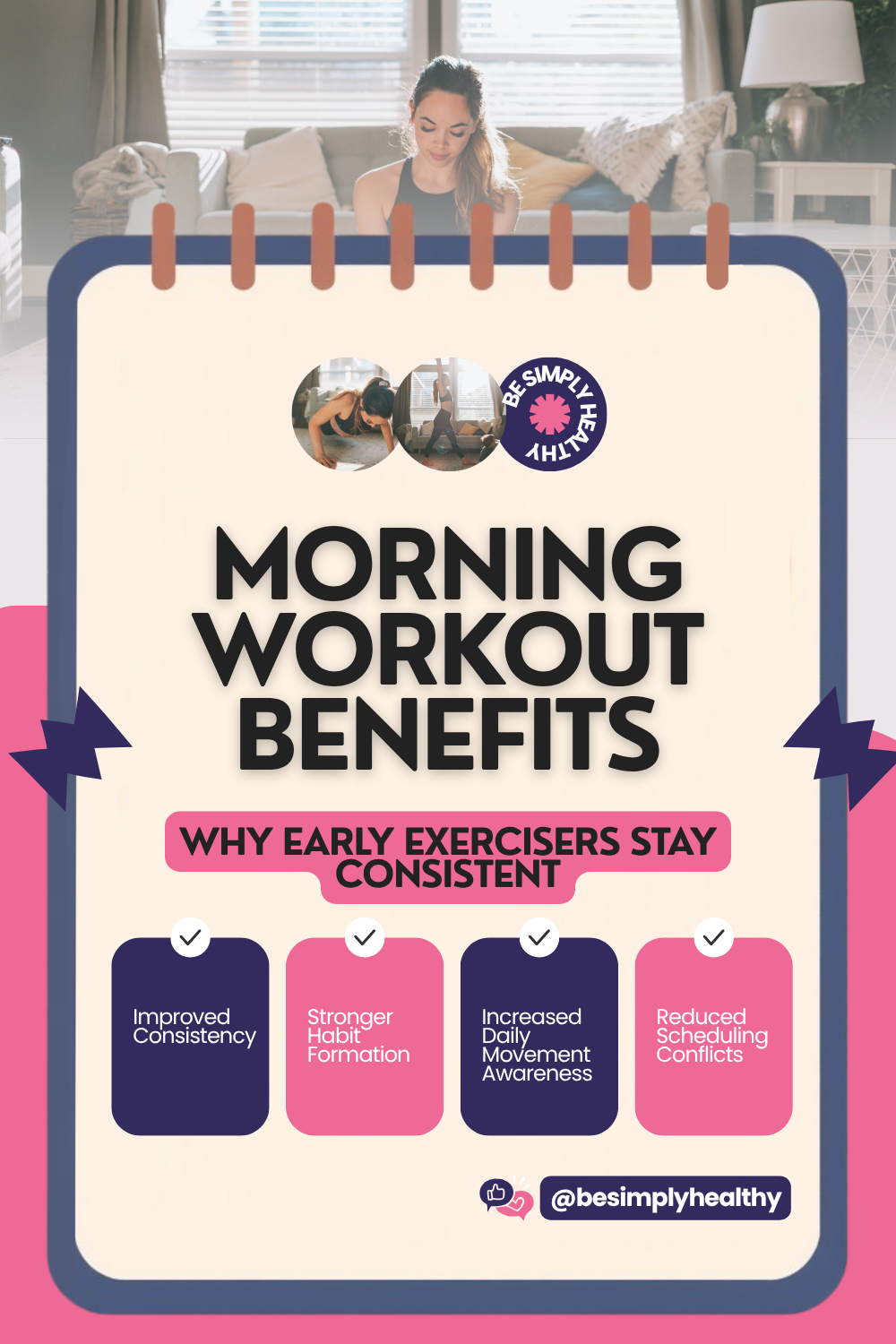
Morning Workout Benefits
Morning exercise offers several practical advantages.
1. Improved Consistency
Many people find it easier to exercise before work, school, or family responsibilities begin.
Unexpected events are less likely to interfere with a workout completed early in the day.
For beginners, this can be a major advantage.
2. Strong Habit Formation
Morning exercise often becomes part of a predictable routine.
Repeating behaviors in a consistent environment may help strengthen long-term exercise habits.
3. Increased Daily Movement Awareness
Some people report that exercising in the morning encourages healthier choices throughout the day.
This may include:
- •More walking
- •Better food choices
- •Greater awareness of health goals
4. Reduced Scheduling Conflicts
Evening commitments frequently disrupt workout plans.
Morning sessions can eliminate many of these conflicts.
5. Potential Mental Health Benefits
Physical activity can improve mood, reduce stress, and increase feelings of well-being.
For some individuals, starting the day with exercise creates a positive tone for the hours ahead.
Potential Drawbacks of Morning Workouts
Morning exercise is not perfect for everyone.
Challenges may include:
Lower Energy Levels
Some people naturally feel sluggish early in the day.
Reduced Performance
Strength, power, and flexibility may be slightly lower immediately after waking.
Earlier Wake Times
Morning workouts may require adjusting sleep schedules.
Consistently sacrificing sleep to exercise is generally not recommended.
Evening Workout Benefits
Evening workouts also provide meaningful advantages.
1. Improved Physical Performance
Research has found that strength, power, and exercise capacity may be higher later in the day.
Possible reasons include:
- •Higher body temperature
- •Increased muscle function
- •Greater flexibility
- •Improved neuromuscular efficiency
2. Better Workout Quality
Many people feel stronger and more energetic during afternoon or evening training sessions.
This may allow:
- •Heavier lifting
- •More repetitions
- •Better endurance
- •Higher training intensity
3. Stress Relief
Exercise after work can help relieve mental stress accumulated throughout the day.
4. Easier Nutrition Timing
Some individuals prefer training after consuming several meals, which may support exercise performance and comfort.
5. Social Opportunities
Evening fitness classes, group activities, and gym sessions may fit more naturally into some schedules.
Potential Drawbacks of Evening Workouts
Evening exercise also presents challenges.
Schedule Interruptions
Work responsibilities, family obligations, and social events may interfere with training plans.
Fatigue After Long Days
Mental exhaustion can reduce motivation.
Sleep Considerations
Current evidence does not suggest that all evening exercise harms sleep.
However, some people may experience difficulty falling asleep after very intense late-night workouts.
Individual responses vary.
Morning vs Evening Workouts for Fat Loss
This is where many misconceptions occur.
Fat loss occurs when the body consistently uses more energy than it consumes over time.
Key drivers include:
- •Nutrition habits
- •Physical activity
- •Sleep quality
- •Stress management
- •Long-term consistency
Current evidence does not strongly support the idea that one workout time dramatically outperforms the other for long-term fat loss.
The difference between exercising consistently and not exercising consistently is far more important than the difference between morning and evening exercise.
Does Fasted Morning Cardio Burn More Fat?
Fasted cardio remains one of the most debated topics in fitness.
The theory is simple:
Exercise before breakfast may increase fat oxidation during the workout session.
However, increased fat use during a workout does not automatically translate into greater long-term fat loss.
Overall daily energy balance remains the primary factor.
For many people:
- •Fasted cardio is acceptable.
- •Fed cardio is acceptable.
- •Personal preference matters.
The best choice is usually the option that feels sustainable and supports consistent exercise. ## Does Workout Timing Affect Muscle Growth?
For individuals focused on building muscle, workout quality and progressive overload are generally more important than workout timing.
Muscle growth is influenced by:
- •Resistance training quality
- •Training volume
- •Protein intake
- •Recovery
- •Sleep
- •Consistency
Evening workouts may allow some people to lift heavier due to improved performance later in the day.
However, morning workouts can be equally effective when performed consistently.
Morning vs Evening Workouts for Beginners
Beginners often benefit most from simplicity.
Ask yourself:
Can I Consistently Exercise Before Work?
If yes, morning workouts may be ideal.
Do I Feel More Energetic Later in the Day?
If yes, evening workouts may be a better fit.
Which Schedule Causes Less Stress?
Choose the option that feels sustainable rather than forcing a routine that creates unnecessary friction.
Who Should Consider Morning Workouts?
Morning exercise may be especially useful for:
- •Busy professionals
- •Parents with unpredictable evenings
- •Individuals who enjoy structured routines
- •People who prefer exercising before daily distractions appear
- •Those seeking stronger habit formation
Who Should Consider Evening Workouts?
Evening exercise may be especially useful for:
- •People who feel stronger later in the day
- •Individuals who dislike early mornings
- •Strength-training enthusiasts
- •People with flexible evening schedules
- •Those who enjoy group classes or gym sessions after work
Common Workout Timing Myths
Myth 1: Morning Workouts Burn Significantly More Fat
Reality:
Current evidence does not support dramatically greater long-term fat loss from morning exercise alone.
Consistency and energy balance remain more important.
Myth 2: Evening Workouts Ruin Sleep
Reality:
Many people tolerate evening exercise well.
Some individuals may experience sleep disruption after very intense late-night sessions, but responses vary.
Myth 3: Fasted Cardio Is Required for Weight Loss
Reality:
Fasted cardio is a preference, not a requirement.
Both fed and fasted exercise can support fat loss when part of a sustainable plan.
Myth 4: There Is One Best Workout Time for Everyone
Reality:
Individual schedules, energy levels, responsibilities, and preferences all influence success.
Comparison Table
| Factor | Morning Workouts | Evening Workouts | |----------|----------|----------| | Consistency Potential | Often High | Variable | | Strength Performance | Moderate | Often Higher | | Schedule Conflicts | Usually Lower | Often Higher | | Habit Formation | Strong | Moderate | | Flexibility | Lower | Higher | | Fat Loss Potential | Similar | Similar | | Muscle Growth Potential | Similar | Similar | | Stress Relief | Good | Excellent |
Practical Decision Guide
Choose Morning Workouts If:
- •You frequently miss evening sessions
- •You enjoy structured routines
- •You want fewer scheduling conflicts
- •You feel energized after waking
Choose Evening Workouts If:
- •You feel physically stronger later in the day
- •Your mornings are rushed
- •You prefer training after meals
- •You consistently have time after work
Sample Morning Workout Routine
5-Minute Warm-Up
- •Walking
- •Marching in place
- •Dynamic stretching
Strength Circuit
- •Squats
- •Push-ups
- •Lunges
- •Rows
- •Planks
Cool Down
- •Walking
- •Light stretching
Total time: 25-40 minutes
Sample Evening Workout Routine
5-Minute Warm-Up
- •Brisk walk
- •Mobility exercises
Strength Training
- •Squats
- •Deadlifts
- •Presses
- •Rows
Finisher
- •Moderate cardio
Cool Down
- •Stretching
Total time: 30-60 minutes
How to Stay Consistent Regardless of Workout Time
Schedule Workouts Like Appointments
Treat exercise as a non-negotiable part of your calendar.
Prepare in Advance
Lay out workout clothes and equipment before your session.
Start Small
A short workout consistently performed is more effective than an ambitious plan that gets abandoned.
Focus on Progress
Track:
- •Workouts completed
- •Strength gains
- •Energy levels
- •Walking goals
Protect Sleep
Sleep is one of the most important factors influencing recovery, health, and long-term fitness results.
FAQ
Are morning workouts better for weight loss?
Not necessarily. Current evidence suggests that consistency, nutrition, and total activity matter more than workout timing.
Are evening workouts better for building muscle?
Evening workouts may allow slightly higher performance for some people, but muscle growth depends primarily on training quality, nutrition, recovery, and consistency.
Should I do fasted cardio?
Fasted cardio is optional. Some people enjoy it, while others perform better after eating. Neither approach is clearly superior for long-term fat loss.
Can evening workouts affect sleep?
Some individuals may experience sleep disruption after very intense late-night training, while many people experience no issues.
What is the best time to exercise?
The best time is typically the time that fits your lifestyle and allows you to exercise consistently.
Conclusion
The debate between morning and evening workouts often misses the most important point.
Both can be effective.
Morning workouts may help improve consistency and habit formation.
Evening workouts may support stronger exercise performance and workout quality.
For fat loss, fitness, and long-term health, consistency remains the deciding factor.
Rather than searching for the perfect workout time, focus on creating a routine that fits your life, supports recovery, and allows you to stay active for months and years.
The most effective workout is usually the one you can maintain consistently.
Comments (0)
Share your thoughts and experiences
No comments yet. Be the first to share your thoughts!