
Home Workouts vs Gym Workouts: Which Is Better for Fat Loss?
Home workouts and gym workouts can both support fat loss. Compare results, cost, equipment, convenience, and progression to choose the setup you can sustain.
Click a star to rate
Home workouts and gym workouts can both help you lose fat, get stronger, and feel more capable. The better choice is rarely the one with the most equipment. It is the one you can do consistently, progress over time, and fit into your real week.
For a beginner focused on fat loss, home workouts are often easier to start because there is no commute, membership contract, or pressure to know how every machine works. A gym becomes more useful when you need heavier equipment, more exercise options, a stronger training routine, or an environment that makes you show up.
This is a researched comparison based on current physical-activity guidance and established training principles. No equipment or gym facilities were personally tested for this article.
The Short Answer: Choose the Setup That Removes Your Biggest Barrier
Choose home workouts if your main barrier is time, travel, cost, or feeling uncomfortable in a gym. A small amount of equipment can create a very effective beginner routine.
Choose gym workouts if your main barrier is knowing how to progress, staying motivated at home, or having enough resistance for long-term strength training. A gym gives you more ways to train each muscle group as you get stronger.
Neither location causes fat loss by itself. Fat loss comes from a sustained energy deficit, regular movement, and a training plan you can repeat. Strength training helps preserve or build muscle while you lose weight, while cardio and daily movement can help increase energy expenditure.
Current guidance from the World Health Organization and CDC recommends that adults work toward at least 150 minutes of moderate-intensity aerobic activity weekly, plus muscle-strengthening work for major muscle groups on two or more days per week. You can meet those targets at home, at a gym, outdoors, or through a mix of settings.
Home Workouts vs Gym Workouts at a Glance
| Factor | Home Workouts | Gym Workouts |
|---|---|---|
| Convenience | Excellent. No commute and easier to fit into short time blocks. | Depends on travel time, opening hours, and crowd levels. |
| Upfront cost | Can be free with bodyweight training; equipment costs rise as you build a setup. | Usually requires a monthly membership and possible joining fees. |
| Exercise variety | Limited without equipment, but enough for a strong beginner plan. | High. Machines, free weights, cables, cardio equipment, and classes offer many options. |
| Long-term progression | Possible with dumbbells, bands, tempo, and single-leg work; may become harder with limited load. | Easier because you can increase resistance in smaller, more regular increments. |
| Beginner comfort | Private and low-pressure. | Helpful for people who like structure, but intimidating for some beginners. |
| Form feedback | Requires videos, mirrors, careful pacing, or coaching. | Staff, trainers, classes, and mirrors may provide more feedback, though quality varies. |
| Accountability | Depends on your routine and home environment. | A paid membership, scheduled class, or workout partner can encourage attendance. |
| Best fit | Busy people, budget-conscious beginners, people who prefer privacy. | People who enjoy the environment, need more equipment, or want to train heavier. |
What Actually Matters for Fat Loss
A gym membership is not a fat-loss requirement. Home exercise is not automatically less effective. The bigger question is whether your setup helps you do enough useful activity each week.
Training consistency matters more than a perfect program
A 35-minute home workout completed three times every week is more useful than an ambitious gym routine you only manage twice a month.
The American College of Sports Medicine's 2026 resistance-training guidance emphasizes a practical point: regular training is more important than chasing a complex “perfect” program. For beginners, moving from no resistance training to a consistent routine can create meaningful improvements in strength and physical function.
Before choosing a location, ask:
- •Can I realistically train here two to four times each week?
- •Does getting there take so long that I will skip it after a busy day?
- •Do I have enough privacy, space, or confidence to focus?
- •Can I make the exercises more challenging over time?
- •Will I still use this setup after the first burst of motivation fades?
Fat loss needs more than workouts
Workouts can support fat loss, but they do not erase the effect of eating patterns, sleep, stress, or a very sedentary day.
A common mistake is treating exercise as punishment for food or expecting a few hard sessions to create a large calorie deficit. A better approach is to combine strength training, cardio you can tolerate, more daily walking or movement, and meals that are satisfying enough to repeat.
The ideal workout location is the one that makes that full routine easier.
When Home Workouts Are the Better Choice
Home workouts are not just a backup option for people who cannot get to a gym. They can be a smart first choice, especially when convenience is your main challenge.
You have limited time
If going to the gym takes 20 minutes each way, a “one-hour workout” may actually require close to two hours once you include travel, changing clothes, waiting for equipment, and showering.
At home, you can train for 20 to 40 minutes before work, after dinner, or between responsibilities. That flexibility is valuable for beginners who are still building the habit.
A realistic example:
A parent with a busy weekday schedule may skip a gym session after a long commute. The same person may consistently complete three 30-minute home sessions using adjustable dumbbells and a mat. The home plan is likely the better plan because it happens.
You prefer privacy while learning
Many beginners worry that people will watch them exercise incorrectly. Most gym-goers are focused on their own workout, but the discomfort can still be real.
Home training gives you room to learn squats, hinges, rows, presses, and modified push-ups at your own pace. You can pause a video, repeat a movement, or take longer rests without feeling rushed.
Privacy is especially useful if gym anxiety is the reason you have delayed starting.
You are starting with a tight budget
Bodyweight exercises cost nothing. You can make a simple routine from squats, lunges, glute bridges, push-up variations, planks, step-ups, and brisk walking.
If you want to add equipment gradually, prioritize tools that allow several exercises rather than buying many single-use items.
A practical beginner home setup may include:
- •An exercise mat for floor work
- •Resistance bands for pulling exercises and added resistance
- •Adjustable dumbbells for squats, presses, rows, deadlifts, and lunges
- •A stable chair or bench for supported movements and step-ups
You do not need every item at once. Start with the equipment that solves a real limitation in your routine.
You are more likely to move in short sessions
Home training makes exercise snacks easier. A 10-minute incline walk, a few sets of dumbbell rows, or a short lower-body session can be useful when added to a consistent week.
Short sessions are not a substitute for all planned exercise, but they can reduce the “I have no time” problem. For many people, more frequent movement is a better starting point than waiting for a perfect 60-minute workout window.
Where Home Workouts Can Become Limiting
Home workouts have tradeoffs. Ignoring them can lead to stalled progress or a routine that becomes boring.
Progress can get difficult with only bodyweight
Bodyweight movements can be challenging at first, but some exercises become easier as you adapt. You can make them harder by slowing the lowering phase, adding repetitions, using pauses, reducing stability, or switching to single-leg variations.
Those methods work, but eventually you may need more resistance to keep progressing efficiently.
For example, a beginner may start with bodyweight squats, move to split squats, then hold dumbbells. If the heaviest dumbbells available are still too light, it becomes difficult to train the legs with the same progressive loading available at a gym.
Pulling exercises need planning
Push-ups, squats, lunges, and glute bridges are easy to adapt at home. Back training can be harder without a pull-up bar, bands, dumbbells, or a safe anchoring setup.
A balanced home plan should include a pulling movement such as a dumbbell row, band row, or assisted pull-up variation. Do not build a routine around only push-ups and ab exercises.
💡 Recommended Product: Amazon Basics Neoprene Dumbbell Hand Weights for Exercise and Muscle Toning. 2 each of 2, 3, and 5 pound dumbbell hand weights (6 total) for exercise and strength training, plus an easy-to-assemble storage stand
View on Amazon →Home distractions are real
The same convenience that makes home exercise easy can make it easy to postpone. Work notifications, family responsibilities, chores, television, and a comfortable couch can all compete with your training time.
If this sounds familiar, use simple structure:
- •Put workouts in your calendar.
- •Set out your clothes and equipment before the session.
- •Use a written plan instead of deciding exercises in the moment.
- •Choose a fixed training cue, such as immediately after coffee or before your evening shower.
- •Keep sessions short enough that starting does not feel overwhelming.
When Gym Workouts Are the Better Choice
A gym is not automatically better, but it offers tools that make certain goals easier.
You want easier long-term progression
The main advantage of a gym is progressive overload. You can gradually increase weight, use machines that stabilize your body, and choose exercises that match your comfort and mobility.
A beginner may start with a leg press, chest press, seated row, lat pulldown, and cable exercises before feeling ready to use barbells. Small weight increases can make progression more manageable than trying to make a light home workout endlessly harder.
This does not mean machines are required. It means they are useful tools for people who want a straightforward way to challenge muscles over time.
You need an environment that helps you focus
Some people can work from home but cannot exercise at home. Once they arrive at the gym, they mentally switch into workout mode.
The gym may also help if you enjoy music, classes, training partners, or seeing other people exercise. Motivation is not the only reason to train, but an environment that makes training more appealing can improve consistency.
You want more cardio options
Walking outside and home cardio videos can work well. Still, a gym gives you treadmills, bikes, rowing machines, stair climbers, ellipticals, and sometimes pools or group classes.
That variety can be useful if you dislike one form of cardio or need low-impact options. A person with knee discomfort, for example, may find a stationary bike more comfortable than repeated jumping workouts.
You value form support or coaching
A qualified trainer can help with exercise selection, basic technique, and confidence. Group classes may also give structure to people who do not want to plan each workout.
However, gym staff availability and trainer quality differ widely. A membership does not guarantee individual instruction. If coaching is important, ask what onboarding, induction, or trainer support is included before joining.
Where Gym Workouts Can Fall Short
A gym membership is only valuable if you use it enough to justify the cost and travel.
The commute can quietly reduce your training frequency
A gym that is cheaper but far away may cost more in missed workouts than a nearby facility with a slightly higher monthly fee.
Before signing a contract, do a realistic trial: visit at the time you would normally train. Notice traffic, parking, crowding, shower access, and whether the equipment you need is available.
Crowding can frustrate beginners
A crowded gym can make a simple routine feel complicated. You may wait for machines, feel rushed near free weights, or avoid areas that seem intimidating.
A flexible program helps. Instead of needing one exact exercise, use movement categories:
- •Squat or leg press
- •Hip hinge or hamstring curl
- •Chest press or push-up
- •Row or lat pulldown
- •Shoulder press
- •Core exercise
This lets you substitute without abandoning the workout.
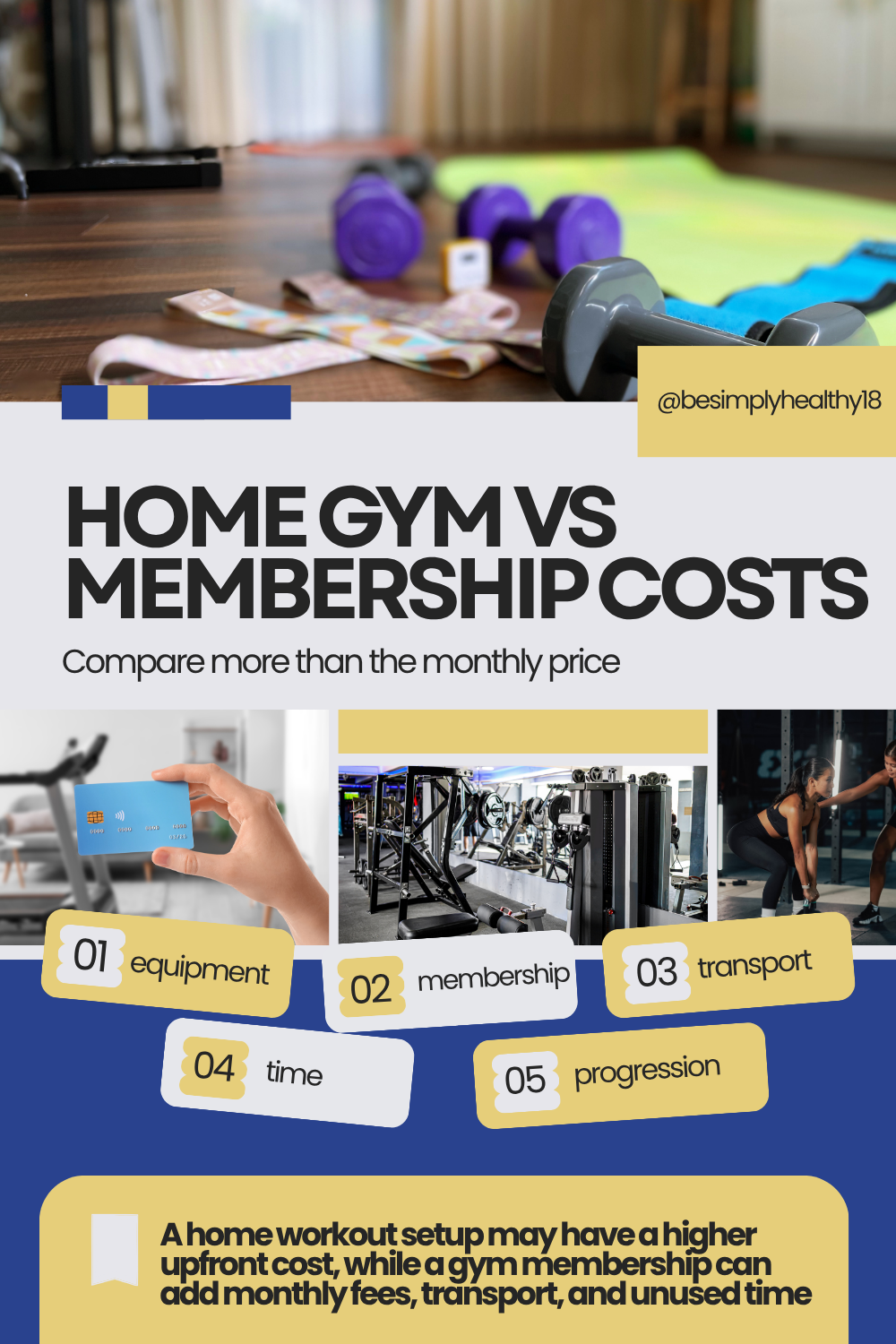
Membership costs are ongoing
A home setup may cost more at the beginning but can last for years. A gym spreads the cost monthly but continues as long as you remain a member.
There is no universal cheaper option. Compare the true cost:
| Expense | Home Workout | Gym Workout |
|---|---|---|
| Initial spending | May include a mat, bands, dumbbells, or a bench. | May include a joining fee, first month, transport, and basic workout clothing. |
| Monthly spending | Often none after equipment purchases; optional apps or coaching may add cost. | Membership, transport, lockers, classes, or trainer sessions may add cost. |
| Long-term value | High if equipment is used consistently and still suits your progression. | High if you use the facility regularly and benefit from its equipment and environment. |
Avoid buying expensive equipment or committing to a long contract before you have built a basic routine.
Can You Build Muscle With Home Workouts?
Yes. Home workouts can build muscle when exercises are challenging enough, training is consistent, and you gradually increase the difficulty.
For beginners, bodyweight training, resistance bands, and dumbbells can provide enough stimulus to improve strength and build muscle. The challenge is maintaining progression as you get stronger.
You do not need to train to failure on every set, but the final repetitions should feel meaningfully difficult while your form remains controlled. If you can easily perform many extra repetitions, it is time to make the exercise harder.
Ways to progress a home workout include:
- •Adding weight with dumbbells or a loaded backpack
- •Choosing a more difficult variation
- •Adding a repetition or set
- •Slowing the lowering phase
- •Pausing at the hardest part of the movement
- •Reducing support in a movement such as a split squat
- •Improving range of motion when safe and controlled
A gym makes this process simpler, but it does not replace effort or consistency.
Can You Lose Weight With Home Workouts Only?
Yes. You can lose weight with home workouts only, provided your overall routine supports a calorie deficit and you can stay consistent.
Home workouts are especially useful when they lower the threshold for exercise. If you can walk on a treadmill, follow a dumbbell routine, or complete bodyweight circuits at home more regularly than you would visit a gym, they may be the stronger fat-loss choice for you.
Do not expect home workouts to compensate for a routine that includes very little movement outside the workout. Pair them with regular walking, household activity, standing breaks, or other movement you enjoy.
A Better Decision Framework Than “Which Is Best?”
Use these five questions before spending money.
1. Where will I exercise most weeks, not just during my motivated weeks?
Choose the setting that fits your ordinary schedule. Your work hours, commute, family responsibilities, energy level, and budget matter more than an ideal routine on paper.
2. What type of barrier is most likely to stop me?
If travel stops you, train at home.
If distractions stop you, use a gym.
If intimidation stops you, start privately or choose a quieter gym with a beginner induction.
If boredom stops you, consider a gym, outdoor walking, classes, or a mixed routine.
3. Can my plan become harder over time?
At home, this may mean buying adjustable dumbbells or bands later.
At a gym, it may mean learning a few basic machine or free-weight movements rather than changing your whole plan every week.
4. Can I afford this without guilt or pressure?
Avoid a membership that strains your budget or equipment purchases that sit unused. A low-cost plan you repeat is better than an expensive plan you avoid.
5. Do I enjoy the experience enough to repeat it?
You do not need to love every workout. But you should not dread the process so much that you constantly look for reasons to skip it.
The Best Option for Most Beginners: Use a Hybrid Plan
You do not have to choose one setting forever.
A hybrid plan can work well if you have gym access but need flexibility:
- •Two gym strength sessions each week
- •One short home dumbbell or bodyweight session
- •Regular walking, cycling, or low-impact cardio on other days
This approach gives you access to heavier equipment while protecting your routine when work, weather, travel, or gym schedules get in the way.
A hybrid setup can also make a gym membership more valuable because home sessions stop an imperfect week from becoming a zero-exercise week.
A Simple Starting Plan
If you choose home workouts, begin with two or three full-body sessions per week. Include a squat or lunge, hip hinge or glute bridge, push, pull, and core movement. Add walking or another form of cardio you can do consistently.
If you choose a gym, start with two or three full-body sessions using machines or free weights you can control safely. Keep the routine simple enough that you can remember it without spending half the session searching for exercises.
For either option, give yourself four weeks before judging the plan. Track completed sessions, not just scale weight. Strength, energy, confidence, steps, and waist measurements may also show progress.
FAQ
Are home workouts as effective as gym workouts?
They can be, especially for beginners. Effectiveness depends on consistency, exercise difficulty, progression, and the overall plan. Gyms make heavier loading and exercise variety easier, while home workouts often make regular attendance easier.
Is a gym better for weight loss?
Not necessarily. A gym can provide useful equipment and structure, but it does not create fat loss on its own. The better choice is the setting that helps you exercise regularly while supporting healthy eating and daily movement.
What is the best home workout equipment for beginners?
A mat, resistance bands, and adjustable dumbbells cover many useful exercises without requiring a full home gym. Start with the minimum equipment that helps you train consistently.
How many days a week should a beginner work out?
Many beginners do well with two to three strength-training sessions per week, plus regular aerobic activity and more everyday movement. Build gradually rather than starting with a schedule that is difficult to sustain.
Should I join a gym if I have never exercised before?
You can, but it is not required. Look for a gym that feels accessible, offers an orientation, has equipment you feel comfortable using, and is close enough to visit regularly. Home workouts are also a valid way to begin.
Conclusion
Home workouts are usually better when convenience, privacy, and lower ongoing costs help you stay consistent. Gym workouts are usually better when you need more equipment, clearer ways to progress, and an environment that helps you focus.
For fat loss, do not choose based on which option looks more serious. Choose the option that you can repeat during a normal, busy week. Start with two or three strength sessions, add regular movement, and make your plan slightly more challenging as your fitness improves.
Sources
- •World Health Organization. Physical activity recommendations for adults: https://www.who.int/initiatives/behealthy/physical-activity
- •Centers for Disease Control and Prevention. Adult activity guidelines: https://www.cdc.gov/physical-activity-basics/guidelines/adults.html
- •American College of Sports Medicine. Updated resistance training guidance, published March 17, 2026: https://acsm.org/resistance-training-guidelines-update-2026
Comments (0)
Share your thoughts and experiences
No comments yet. Be the first to share your thoughts!