Bodyweight Training vs Weights: What’s Better for Fat Loss?
A practical comparison of bodyweight training and weights for beginners who want to lose fat, build strength, and choose a workout plan they can sustain.
Click a star to rate
If your goal is fat loss, start with the training method you can do consistently and make gradually harder. For many beginners, that means bodyweight training first. Weights become especially useful when basic movements no longer challenge you enough, you want more reliable progression, or you need a practical way to train your back, legs, and arms.
Affiliate disclosure: This article may contain affiliate links. If you buy through one of them, the site may earn a commission at no extra cost to you. Recommendations should be based on fit and usefulness, not commission.
Neither method creates fat loss on its own. A sustainable calorie deficit, everyday movement, sleep, and food habits matter most for body-weight change. Resistance training has a different job: it helps you become stronger and can help preserve muscle while you lose weight. That is valuable whether the resistance comes from your body, dumbbells, machines, bands, or a mix of them.
The quick answer
Choose bodyweight training if you are new to exercise, want a no-cost home routine, need to learn movement control, or are rebuilding the habit of working out. Squats, incline push-ups, split squats, glute bridges, planks, and step-ups can be very challenging when they are selected and progressed well.
Choose weights if you want a clearer way to get stronger over time, need more resistance for your legs or pulling muscles, or find that you can already do long sets of bodyweight exercises without much effort. Adjustable dumbbells are often the most practical first purchase because you can increase load in small steps.
The strongest beginner plan is usually not bodyweight *or* weights. It is bodyweight movements for skill and convenience, plus a few weighted exercises once you are ready to progress.
Bodyweight training vs weights at a glance
| If this sounds like you | Start with bodyweight training | Start with weights |
|---|---|---|
| You have no equipment and want to begin this week. | Yes. Use simple movements and a repeatable schedule. | Not necessary yet. |
| You are learning how to squat, push, brace, and control your range of motion. | Yes. Lower complexity can make practice less intimidating. | Add light weights after you can move with control. |
| You want stronger legs but bodyweight squats feel easy. | Progress to split squats, tempo reps, or step-ups first. | Dumbbells can make lower-body progression much easier. |
| You want to train your back at home. | Pulling options are limited without a bar, rings, or a sturdy row setup. | A dumbbell or band makes rows easier to program. |
| You dislike gyms or have a limited budget. | A full workout is possible with no purchase. | Buy only when equipment solves a real progression problem. |
| You want to build strength over months and years. | Possible, but exercise variations eventually become awkward or highly technical. | Usually the more straightforward route. |
What each method actually means
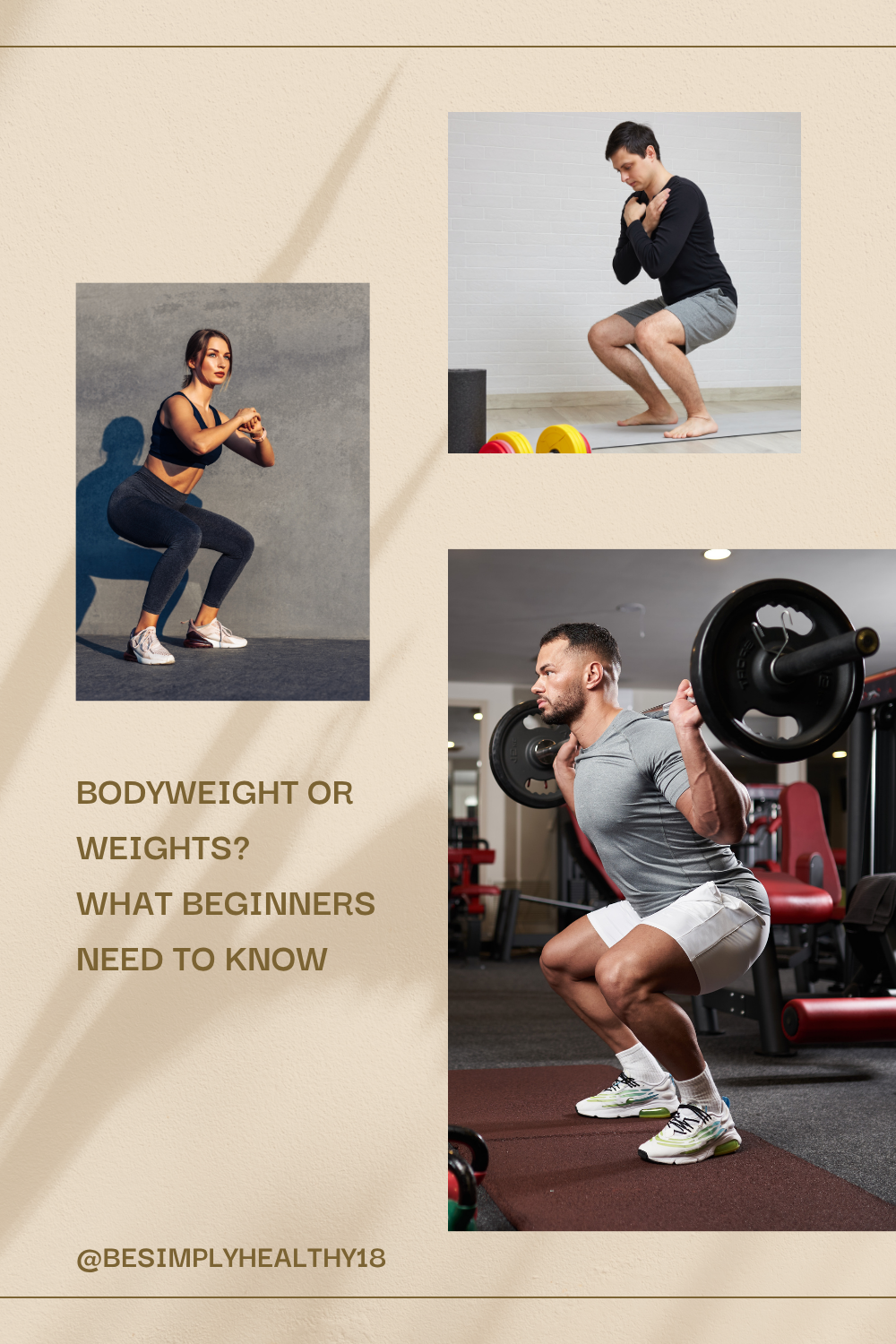
Bodyweight training uses your own mass as resistance. Push-ups, lunges, squats, bridges, planks, inverted rows, and pull-ups all fall into this category. It does not have to mean easy exercise. A controlled single-leg squat variation can challenge someone far more than a rushed set of light dumbbell squats.
Weight training means using external load, such as dumbbells, barbells, kettlebells, machines, cables, or weighted bags. The main advantage is not that weights are automatically superior. It is that you can adjust resistance more precisely. When eight goblet squats become manageable, you can use a slightly heavier dumbbell rather than trying to turn the movement into a complicated balance drill.
Both are forms of resistance training. The important question is whether the exercise gives the target muscles enough effort, can be performed safely, and can be progressed over time.
For fat loss, consistency matters more than the tool
It is tempting to choose workouts based on which one appears to burn more calories. That is too narrow a test. Calorie use during a session varies with body size, pace, rest time, exercise selection, and how hard you work. It is also easy to overestimate it.
For fat loss, choose a routine you can repeat two or three times a week without dreading it. A 25-minute bodyweight workout done every week is more useful than a complicated gym plan you abandon after three sessions. The same is true in reverse: if bodyweight circuits bore you but you enjoy tracking your dumbbell lifts, weights may be the more sustainable choice for you.
Adults benefit from regular aerobic activity and muscle-strengthening work for all major muscle groups on at least two days a week. That guidance does not require a gym. The method can be bodyweight, free weights, bands, or machines. For a beginner focused on fat loss, a simple combination of strength work, walking or other cardio, and realistic nutrition changes is usually easier to sustain than trying to make one type of workout do everything.
Where bodyweight training shines
It removes the starting barrier
No commute, membership, delivery, or equipment research is required. You can begin with a chair, a clear patch of floor, and perhaps a wall or countertop. That matters because the first win is often simply becoming someone who trains regularly.
It teaches control before load
Many beginners benefit from learning to keep their feet stable in a squat, control a push-up descent, and brace their trunk during a split squat. Bodyweight exercises provide feedback. If your knee collapses inward, your lower back arches during a plank, or you cannot control the lowering phase, adding load will not fix the pattern.
It is portable and flexible
A bodyweight session works in a small room, hotel, park, or busy day at home. You can also use it as a short fallback workout when a full gym session is not realistic. That protects consistency rather than creating an all-or-nothing routine.
It can be genuinely demanding
The mistake is assuming that 30 fast squats are the only way to make bodyweight training harder. You can increase range of motion, slow the lowering phase, pause at a hard position, use one leg at a time, elevate your feet, or add more sets. For example, progressing from a countertop push-up to an incline push-up, then a knee push-up, then a floor push-up can build meaningful strength.
Where weights have the edge
Progression is clearer
Progressive overload means gradually asking your muscles to do more than they are used to. With weights, this can be as simple as adding one or two kilograms, doing an extra repetition with the same good form, or completing another set. The change is measurable and easy to repeat.
Bodyweight progression is possible, but it can become less tidy. After regular squats become easy, you might move to a Bulgarian split squat, then add pauses, then use a backpack. Those are useful options, but a pair of dumbbells often makes the next step simpler.
Pulling exercises become more practical
Home bodyweight routines often contain plenty of pushing—push-ups, planks, and shoulder variations—but little pulling. Your back muscles still need attention. A dumbbell row, supported one-arm row, or resistance-band row gives you a straightforward way to train them. If you use a pull-up bar or rings, bodyweight pulling can also work very well, but those are still pieces of equipment.
Legs can keep progressing without extreme variations
Strong legs need enough challenge. Single-leg bodyweight exercises can be difficult, but they also demand balance and coordination. Holding dumbbells for a squat, Romanian deadlift, lunge, or step-up lets you challenge the legs while using simpler movement patterns. That can be useful for beginners who want to improve strength without needing to master advanced calisthenics skills.
Weights allow more targeted work
External load makes it easier to train muscles that bodyweight routines often neglect, such as the upper back, hamstrings, biceps, and shoulders. You do not need isolated exercises to lose fat, but a balanced program can feel better and support long-term strength goals.
The real tradeoff: progression versus convenience
This comparison is not about whether one method is “real” training. It is about what becomes difficult first.
With bodyweight training, convenience is excellent. The limitation is that some muscle groups and strength levels become harder to load progressively. With weights, progression is easier. The tradeoffs are cost, storage, learning basic equipment use, and sometimes the friction of going to a gym.
For a beginner, the best decision is often based on your next three months, not your ideal future setup. If you will train in a small apartment after work, bodyweight workouts plus a resistance band may be more realistic than a gym membership. If you already enjoy lifting and have room for adjustable dumbbells, there is little reason to wait before using them.
Are bodyweight workouts enough to build muscle?
They can be, especially for beginners and for muscles challenged by exercises such as push-ups, split squats, step-ups, glute bridges, rows, and pull-ups. The exercise must be hard enough for your current ability, and your training needs to become more challenging as you adapt.
The limitation is not that bodyweight exercises stop working at a specific number of weeks. The limitation is practical progression. If you can do 25 relaxed squats, adding more and more repetitions may build endurance more than it builds additional strength. A harder variation, a weighted backpack, or dumbbells can bring the effort back into a more useful range.
You do not need to train to complete failure on every set. Instead, use controlled reps and finish most working sets feeling that you could probably do a small number of additional good-form repetitions. If technique breaks down, the set is already hard enough.
Do weights burn more fat than bodyweight exercises?
Not automatically. A hard circuit with bodyweight lunges, incline push-ups, step-ups, and brisk walking can use more energy than a lightly performed dumbbell session. A challenging weight workout with large movements can also be demanding. The outcome depends on the whole session and, more importantly, your weekly routine and eating pattern.
Avoid choosing a program because it promises a particular calorie burn. Fitness trackers and online estimates are imperfect, and trying to “earn” food through exercise can make a plan frustrating. Use training to become stronger, protect muscle, improve fitness, and support a more active life. Use food habits to create an energy intake you can maintain.
A simple progression rule for beginners
Use this rule before buying more equipment: when you can complete the top end of your planned repetitions with steady form for every set, make one small change.
For bodyweight training, progress by choosing one option:
- •Add one or two repetitions per set.
- •Add a set, if recovery is good.
- •Slow the lowering phase to about three seconds.
- •Add a brief pause in the difficult position.
- •Increase the range of motion when it is safe.
- •Move to a slightly harder variation.
For weights, progress by choosing one option:
- •Add one or two repetitions with the same load.
- •Add a small amount of weight.
- •Add one set only when your current workload is manageable.
- •Improve range of motion and control before increasing load.
Change one variable at a time. If you add weight, more sets, more reps, and a faster circuit all at once, it becomes difficult to know why recovery or form changed.
A practical 2-day starter plan
You can use this plan with bodyweight only, then add dumbbells where indicated. Rest around 60 to 90 seconds between sets, longer if you need it to keep your form controlled.
Day A: squat, push, pull, hips, trunk
- Chair squat or bodyweight squat — 2 to 3 sets of 8 to 12 reps. Progress to a goblet squat with one dumbbell.
- Countertop or incline push-up — 2 to 3 sets of 6 to 12 reps. Lower the incline as you get stronger.
- Towel row only if you have a safe, stable setup; otherwise use a band or dumbbell row — 2 to 3 sets of 8 to 12 reps each side.
- Glute bridge — 2 to 3 sets of 10 to 15 reps. Progress to a single-leg bridge or weighted bridge.
- Dead bug or plank — 2 sets of controlled reps or 15 to 30 seconds.
Day B: single leg, push, hinge, pull, carry
- Supported split squat — 2 to 3 sets of 6 to 10 reps each leg. Hold dumbbells when bodyweight becomes manageable.
- Incline push-up or light dumbbell floor press — 2 to 3 sets of 8 to 12 reps.
- Hip hinge practice, then a dumbbell Romanian deadlift if available — 2 to 3 sets of 8 to 12 reps.
- Band row, dumbbell row, or assisted pull-up variation — 2 to 3 sets of 8 to 12 reps.
- Suitcase carry with one dumbbell, or a side plank without equipment — 2 sets each side.
Walk, cycle, dance, or choose another enjoyable activity on additional days. Start with an amount that feels manageable. More activity is not always better if it makes your joints sore, disrupts recovery, or causes you to quit.
Common mistakes when choosing between them
Buying equipment before building the habit
Expensive gear does not solve an inconsistent schedule. Train with what you have for two to four weeks. Then buy the smallest piece of equipment that addresses a clear problem, such as a band for rows or adjustable dumbbells for leg progression.
Treating bodyweight exercises as a beginner-only phase
Push-ups, pull-ups, split squats, and planks can remain useful for years. You do not need to abandon them when you start lifting. Keep the variations you enjoy and load the movements that need more resistance.
Doing only high-rep circuits
Fast circuits can improve conditioning, but they may not provide enough focused resistance for every muscle group. Include controlled strength work, especially for your legs, back, hips, and pushing muscles.
Skipping pulling work
If your plan has push-ups but no rows or pull-ups, it is incomplete. Add a safe row variation, a resistance band, or dumbbells rather than trying unsafe furniture-based exercises.
Making fat loss the only measure of success
Scale weight naturally fluctuates. Track other signals too: better push-up form, a heavier dumbbell, more stable balance, a longer walk, or fewer missed workouts. These are signs that your routine is becoming more sustainable.
Which option should you choose?
Choose bodyweight training if you are starting from zero, have a limited budget, value privacy and convenience, or want to rebuild confidence in basic movements. It is enough to make progress when the exercises are difficult enough and you keep progressing them.
Choose weights if you are ready to invest in a simple setup, want an easier path for loading your legs and back, or have already outgrown basic bodyweight movements. A pair of adjustable dumbbells or a modest gym membership can be more useful than a large collection of random equipment.
Choose a combination if you want the most flexible option. For many people, that looks like push-ups, split squats, planks, and walking alongside dumbbell rows, Romanian deadlifts, goblet squats, and carries.
FAQ
Is bodyweight training better than weights for beginners?
Bodyweight training is often the easiest place to begin because it removes cost and helps you practice basic movement control. Weights are also appropriate for beginners when the load is manageable and the exercises are taught or learned carefully.
Can I lose fat with bodyweight exercises only?
Yes, bodyweight workouts can be part of a fat-loss plan. The result still depends on your overall food intake, activity level, and ability to keep the routine going. Make the exercises challenging enough for your current fitness and pair them with walking or another activity you enjoy.
How many days a week should I do bodyweight or weight training?
Two full-body strength sessions per week is a solid starting point for many beginners. You can add a third session later if you are recovering well and can keep good form.
Do I need a gym to get results?
No. A gym offers more equipment and easier load progression, but bodyweight exercises, resistance bands, and dumbbells can support an effective home routine. The best setup is the one you use consistently.
When should I buy weights?
Consider weights when you can perform the planned bodyweight movements at the top of your rep range with controlled form and they no longer feel challenging, or when you need a safe way to add rows, hinges, carries, and heavier leg work.
Final decision
For fat-loss beginners, start with bodyweight training if it is the option that gets you moving now. Add weights when you need a clearer challenge—not because bodyweight work has failed, but because a little external load can make progression easier.
The useful question is not “Which burns more fat?” It is “Which plan can I perform this week, improve next month, and keep doing long enough for the results to matter?”
Comments (0)
Share your thoughts and experiences
No comments yet. Be the first to share your thoughts!