
Best Mobility Exercises for Adults: Evidence-Based Guide for Better Movement
Discover the best mobility exercises for adults to improve movement quality, joint function, exercise performance, and daily comfort. Learn beginner-friendly routines, common mistakes, and evidence-based mobility strategies.
Click a star to rate

Mobility is one of the most overlooked components of health and fitness, yet it influences how comfortably and efficiently people move every day.
Whether your goal is fat loss, healthy aging, strength training, walking, or simply feeling better during daily activities, mobility plays an important role.
Many adults spend hours sitting at desks, driving, or looking at screens. Over time, this can contribute to stiffness in the hips, shoulders, ankles, and upper back. When movement becomes uncomfortable, exercise often feels harder, and staying active becomes more challenging.
The good news is that mobility can improve with consistent practice.
Unlike complicated workout programs, mobility exercises are often simple, require little equipment, and can fit into almost any schedule.
What Is Mobility?
Mobility refers to your ability to actively move and control a joint through its available range of motion.
Many people use the terms mobility and flexibility interchangeably, but they are not the same thing.
Mobility vs Flexibility
Flexibility refers to the ability of a muscle to lengthen.
Mobility refers to your ability to control movement through a range of motion.
Mobility combines several factors:
- •Flexibility
- •Strength
- •Stability
- •Balance
- •Coordination
- •Motor control
For example, someone may be flexible enough to touch their toes but still struggle to perform a comfortable squat because mobility requires active control, not just muscle length.
Why Mobility Matters
Mobility affects far more than exercise performance.
It influences how you move during everyday activities and may help support long-term physical function.
Supports Daily Movement
Good mobility can make everyday tasks feel easier, including:
- •Walking
- •Climbing stairs
- •Getting up from a chair
- •Reaching overhead
- •Carrying groceries
- •Playing with children
When joints move efficiently, daily activities often feel more comfortable.
Helps Support Exercise Performance
Many exercises require adequate mobility to perform them effectively.
Examples include:
- •Squats
- •Lunges
- •Deadlifts
- •Push-ups
- •Overhead presses
- •Rows
Improved mobility may help support better movement quality during training.
Encourages Consistency
People are more likely to remain physically active when movement feels comfortable.
Mobility work may help reduce the feeling of stiffness that discourages exercise participation.
Supports Healthy Aging
Organizations such as the American College of Sports Medicine emphasize maintaining physical function as people age.
Mobility training can be one practical strategy that supports movement confidence throughout adulthood.
Common Causes of Reduced Mobility
Several factors may contribute to reduced mobility over time.
Prolonged Sitting
Long periods of sitting may contribute to stiffness in:
- •Hip flexors
- •Hamstrings
- •Upper back
- •Chest muscles
- •Ankles
This is one reason desk workers often report feeling stiff after long workdays.
Repetitive Movement Patterns
Performing the same activities repeatedly can reduce exposure to different movement ranges.
Mobility exercises help introduce variety into movement patterns.
Previous Injuries
Injuries may affect movement quality long after symptoms improve.
Individualized guidance from a healthcare professional may be beneficial when injuries are involved.
Low Physical Activity Levels
Movement is a skill that improves through practice.
When activity levels decrease, mobility often decreases as well.
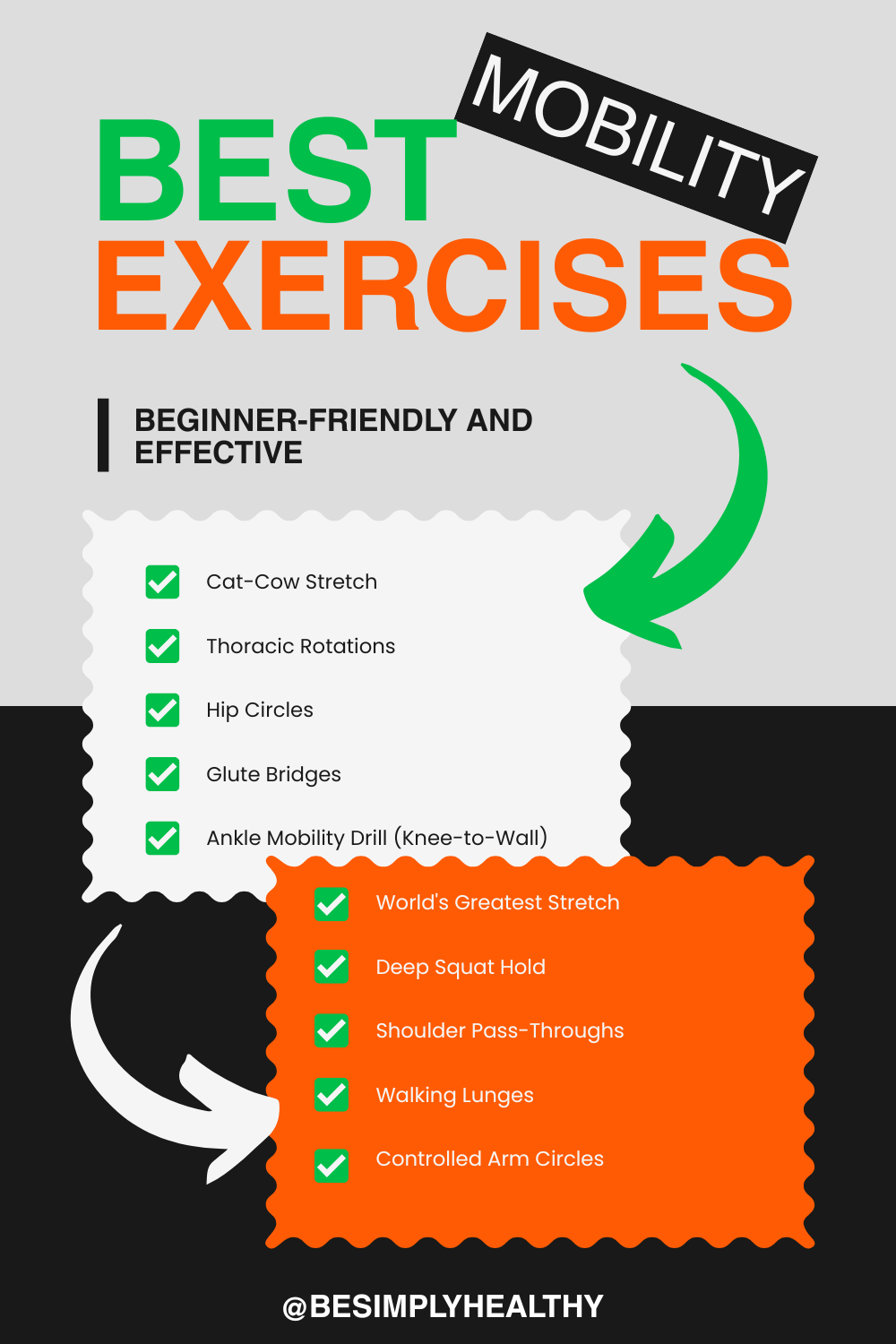
Best Mobility Exercises for Adults
The following exercises target areas that commonly become stiff in modern lifestyles.
These movements are beginner-friendly and require minimal equipment.
1. Cat-Cow Stretch
Benefits:
- •Encourages spinal mobility
- •Improves movement awareness
- •Beginner friendly
- •Useful as a warm-up
How to perform:
- Start on your hands and knees.
- Slowly round your spine upward.
- Slowly arch your back.
- Move smoothly between positions.
- Repeat for 30 to 60 seconds.
2. Thoracic Rotations
Benefits:
- •Improves upper-back mobility
- •Supports rotational movement
- •Useful for desk workers
How to perform:
- Begin on hands and knees.
- Place one hand behind your head.
- Rotate your upper body toward the ceiling.
- Return slowly.
- Repeat on both sides.
3. Hip Circles
Benefits:
- •Improves hip mobility
- •Builds movement awareness
- •Encourages joint control
How to perform:
- Stand tall.
- Lift one knee.
- Draw a slow circle with the hip.
- Reverse direction.
- Repeat on both sides.
4. Glute Bridges
Benefits:
- •Activates the glute muscles
- •Supports hip movement
- •Beginner friendly
How to perform:
- Lie on your back.
- Bend your knees.
- Press through your heels.
- Lift your hips.
- Lower slowly with control.
5. Ankle Mobility Drill
Benefits:
- •Supports walking mechanics
- •Helps improve squat comfort
- •Requires no equipment
How to perform:
- Face a wall.
- Place one foot several inches away.
- Move the knee toward the wall.
- Keep the heel on the floor.
- Repeat on both sides.
- ### 6. World's Greatest Stretch
Benefits:
- •Targets multiple joints simultaneously
- •Encourages full-body mobility
- •Time efficient
- •Popular warm-up movement
How to perform:
- Step into a lunge position.
- Place one hand on the floor.
- Rotate your torso toward the front leg.
- Reach upward.
- Return and repeat.
7. Deep Squat Hold
Benefits:
- •Encourages hip mobility
- •Supports ankle mobility
- •Builds positional awareness
- •Useful for many adults
How to perform:
- Lower into a comfortable squat.
- Keep your chest upright.
- Hold a stable support if needed.
- Breathe normally.
- Hold for 20 to 60 seconds.
8. Shoulder Pass-Throughs
Benefits:
- •Improves shoulder mobility
- •Encourages overhead movement
- •Useful before upper-body training
How to perform:
- Hold a resistance band or towel.
- Keep arms relatively straight.
- Move arms overhead.
- Continue behind the body if comfortable.
- Return slowly.
9. Walking Lunges
Benefits:
- •Dynamic mobility exercise
- •Challenges balance and coordination
- •Encourages hip movement
- •Supports functional fitness
How to perform:
- Step forward into a lunge.
- Lower under control.
- Push through the front foot.
- Bring the back leg forward.
- Continue walking.
10. Controlled Arm Circles
Benefits:
- •Improves shoulder movement
- •Beginner friendly
- •Useful as a warm-up
- •Requires no equipment
How to perform:
- Stand tall.
- Extend your arms to the sides.
- Create small circles.
- Gradually increase the size.
- Reverse direction.
Best Mobility Areas to Prioritize
Many adults benefit from focusing on a few key regions first.
Hips
The hips play a major role in:
- •Walking
- •Running
- •Squatting
- •Climbing stairs
Hip mobility exercises are among the most useful movements for adults who spend long periods sitting.
Ankles
Limited ankle mobility can affect:
- •Walking mechanics
- •Balance
- •Squatting depth
- •Athletic performance
Ankle mobility drills are often overlooked despite their importance.
Thoracic Spine
The thoracic spine refers to the upper and middle back.
Mobility in this area supports:
- •Posture
- •Rotation
- •Overhead movement
- •Exercise technique
Shoulders
Shoulder mobility is important for:
- •Reaching overhead
- •Lifting objects
- •Strength training
- •Daily activities
Sample 10-Minute Daily Mobility Routine
This simple routine works well for beginners.
Minute 1
Cat-Cow Stretch
Minute 2
Thoracic Rotations
Minute 3
Hip Circles
Minute 4
Glute Bridges
Minute 5
Ankle Mobility Drills
Minute 6
Arm Circles
Minute 7
Walking Lunges
Minute 8
World's Greatest Stretch
Minute 9
Deep Squat Hold
Minute 10
Controlled Breathing and Gentle Movement
This routine can be performed:
- •Before workouts
- •On rest days
- •After long periods of sitting
- •As a standalone movement session
Mobility and Fat Loss
Mobility exercises are not high-calorie-burning activities, but they can still support fat-loss goals indirectly.
Better Exercise Participation
When movement feels more comfortable, people may find it easier to:
- •Walk regularly
- •Strength train consistently
- •Participate in recreational activities
- •Maintain exercise habits
Improved Movement Confidence
Feeling capable during movement often encourages long-term physical activity.
Consistency is one of the most important factors in successful fat-loss programs.
Supports Sustainable Habits
Mobility routines are typically short and accessible.
Because they are easy to perform, they may help people build momentum toward broader health goals.
Common Mobility Myths
Myth 1: Mobility Is Just Stretching
Reality:
Mobility includes flexibility, strength, balance, stability, and movement control.
Stretching can be helpful, but mobility involves more than muscle length alone.
Myth 2: Mobility Is Only for Athletes
Reality:
Mobility training may benefit:
- •Office workers
- •Beginners
- •Walkers
- •Older adults
- •Recreational exercisers
Almost everyone uses mobility during daily life.
Myth 3: More Mobility Is Always Better
Reality:
The goal is comfortable, controlled movement.
Extreme ranges of motion are not necessary for most adults.
Myth 4: Mobility Requires Long Workouts
Reality:
Many people benefit from sessions lasting only five to ten minutes.
Consistency usually matters more than duration.
Common Mobility Mistakes
Skipping Warm-Ups
Mobility exercises can help prepare the body for movement.
Moving Too Fast
Control is a key part of mobility training.
Slow, deliberate movement is often more beneficial than rushing through repetitions.
Ignoring Breathing
Breathing helps reduce unnecessary tension and may improve movement quality.
Focusing Only on Problem Areas
While addressing stiff areas is important, a balanced full-body approach is often beneficial.
Expecting Immediate Results
Mobility improvements usually develop gradually through regular practice and consistency. ## How Often Should Adults Do Mobility Exercises?
For most healthy adults, mobility training can be performed regularly.
General recommendations include:
- •Five to ten minutes daily
- •Before workouts as part of a warm-up
- •After prolonged sitting
- •On active recovery days
The best mobility routine is often the one you can perform consistently.
Small amounts of mobility work completed regularly tend to be more sustainable than occasional long sessions.
Evidence-Based Mobility Principles
Research and exercise guidelines consistently support several key concepts.
Consistency Matters More Than Intensity
Mobility improvements are typically the result of repeated practice over time.
Performing a short routine several times per week is often more practical than performing a very long session occasionally.
Active Movement Is Important
Mobility involves actively controlling movement through a range of motion.
This is one reason many mobility drills include movement rather than static positions alone.
Individual Needs Vary
Different people have different mobility limitations.
A desk worker may benefit from focusing on hips and thoracic mobility, while a recreational runner may prioritize ankles and hips.
Pain Is Not the Goal
Mobility exercises should generally feel controlled and comfortable.
Sharp pain is not a sign of productive mobility work.
Individuals experiencing pain should consult an appropriate healthcare professional.
Beginner Mobility Checklist
Use this checklist to build a sustainable mobility habit:
✓ Start with five minutes daily
✓ Focus on hips, ankles, shoulders, and upper back
✓ Move slowly and with control
✓ Breathe normally throughout each exercise
✓ Prioritize consistency over intensity
✓ Track how daily movement feels
✓ Progress gradually
✓ Combine mobility with walking and strength training
Signs Your Mobility May Be Improving
Mobility progress can be subtle.
Potential signs include:
- •Easier squatting
- •More comfortable walking
- •Improved posture awareness
- •Better exercise technique
- •Reduced feelings of stiffness
- •Greater movement confidence
- •Easier stair climbing
- •Improved ability to reach overhead
Progress is not always measured by extreme flexibility.
Often, the most meaningful improvements occur during everyday activities.
FAQ
What are the best mobility exercises for adults?
Cat-cow stretches, thoracic rotations, hip circles, glute bridges, ankle mobility drills, deep squat holds, shoulder pass-throughs, and walking lunges are among the most practical mobility exercises for most adults.
How is mobility different from flexibility?
Flexibility refers to muscle length, while mobility refers to the ability to actively control movement through a range of motion.
Mobility includes flexibility, strength, stability, balance, and coordination.
Can mobility exercises help with weight loss?
Mobility exercises are not primarily designed for calorie expenditure.
However, they may support exercise consistency and physical activity participation, which can contribute to long-term weight-management efforts.
How long does it take to improve mobility?
Results vary based on individual circumstances, consistency, activity level, and starting point.
Many people begin noticing improvements in movement comfort after several weeks of regular practice.
Are mobility exercises safe for beginners?
Most beginner-friendly mobility exercises can be modified to match individual ability levels.
People with injuries, medical conditions, or movement limitations should consult a qualified healthcare professional before starting a new exercise program.
Should mobility exercises be done before or after workouts?
Mobility exercises can be useful both before and after workouts.
Before exercise, they may help prepare the body for movement.
After exercise, they may serve as part of a cool-down routine.
Conclusion
Mobility is an often-overlooked component of overall health, fitness, and healthy aging.
Simple exercises such as cat-cow stretches, thoracic rotations, hip circles, glute bridges, ankle mobility drills, deep squat holds, and shoulder mobility exercises can help adults move more comfortably and confidently.
Rather than waiting until stiffness becomes a major obstacle, developing a short daily mobility routine can support better movement quality, improved exercise participation, and a more active lifestyle.
The goal is not perfect movement.
The goal is building a body that feels capable, comfortable, and ready for daily life.
Read our guide on mobility vs flexibility to better understand how movement quality develops.
Explore our desk worker mobility routine if you spend long hours sitting.
See our beginner walking plan to combine mobility and daily activity.
Learn how strength training and mobility work together for long-term fitness success.
Discover our healthy aging exercise guide for additional evidence-based movement strategies.
Comments (0)
Share your thoughts and experiences
No comments yet. Be the first to share your thoughts!